What Are Crypto Intents
A simple explanation of intent-based transactions in crypto
Crypto intents let users describe outcomes instead of execution steps. Instead of choosing bridges, DEX routes, gas tokens, and settlement paths, the user defines the desired result. The intent system then finds a way to execute it. In simple terms: the user defines the outcome; the execution market handles the path.
1. What Are Crypto Intents?
Crypto intents are outcome-based transaction instructions. A traditional transaction tells a blockchain exactly what to do. An intent tells an execution system what result the user wants, while leaving room for solvers or other execution actors to decide how to achieve that result.[1]
In a normal crypto transaction, the user may need to choose the chain, bridge, decentralized exchange, slippage setting, gas token, and fallback path. That makes even simple on-chain actions complex and error-prone. Account abstraction, such as ERC-4337, can improve wallet-level user experience, but intents address a broader execution problem: how to express desired outcomes without manually constructing every route and transaction step.[2]
Intents flip the model. Instead of defining the journey, the user defines the destination.
Examples of crypto intents include:
- Swap Asset A for Asset B at the best available rate.
- Move funds to Arbitrum and receive at least 100 USDC.
- Convert volatile holdings into stablecoins with the lowest practical fees.
- Execute this trade only if the final output satisfies my price constraint.
The important shift is from instructions to results. Traditional crypto asks users to specify the execution path. Crypto intents ask users to specify the economic outcome.
2. Why Crypto Intents Exist
Crypto is fragmented by design. Assets sit across many Layer 1 and Layer 2 networks. Liquidity is split across decentralized exchanges, bridges, rollups, stablecoins, and routing systems. This fragmentation creates powerful open infrastructure, but it also creates a difficult user experience.
For ordinary users, the pain points are obvious:
- Infrastructure overhead: users must understand chains, bridges, wallets, gas, and liquidity venues.
- Multi-step friction: simple actions can require several sequential transactions.
- Execution risk: transactions can fail because of slippage, stale quotes, gas spikes, or bridge delays.
- Hidden costs: finding the best route across chains and liquidity sources is difficult to do manually.
Crypto intents exist to abstract this complexity. They shift execution responsibility from the user toward specialized actors that compete to satisfy the user’s stated constraints.
3. Crypto Intents vs Traditional Transactions
The key difference is where the technical complexity lives.
| Feature | Traditional Transactions | Crypto Intents |
|---|---|---|
| User focus | Defines execution steps | Defines the final outcome |
| Routing | User selects chains, bridges, and DEXs | Execution actors find a viable path |
| Complexity | High manual effort and technical risk | Lower user friction, more backend coordination |
| Execution model | Path-based: how to execute | Outcome-based: what should happen |
| Failure risk | User often bears failed-transaction friction | Solvers compete to satisfy stated constraints |
The bottom line: traditional crypto is about instructions. Crypto intents are about results.
4. How Crypto Intents Work
Intent-based systems introduce a market-driven execution model. Instead of sending a fully specified transaction directly to a public mempool, a user signs an intent that describes the desired outcome and constraints. That intent is then routed to one or more execution actors.
At its core, this workflow relies on a modular architecture across four layers:
- User or AI agent: signs an intent describing the desired outcome and constraints.
- Solver network: specialized actors compete to find an execution path.
- Liquidity and routing systems: DEXs, bridges, aggregators, and market makers provide the execution venues.
- Settlement layer: the blockchain verifies that the user’s conditions were satisfied before finalizing the result.
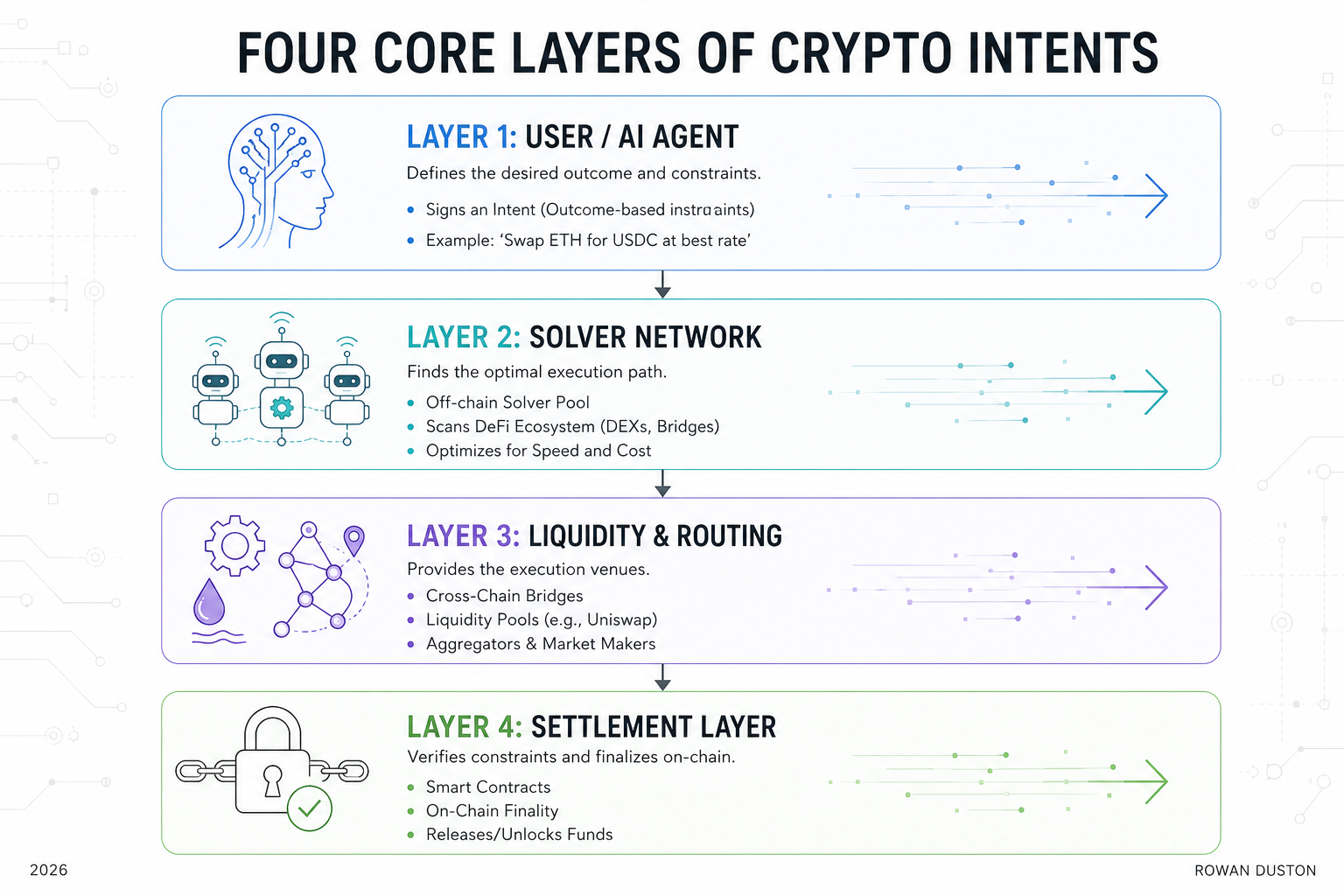
Different systems implement this pattern differently. UniswapX, for example, uses an auction-based model where users create signed orders and fillers compete to satisfy them across liquidity sources.[3] NEAR Intents is one implementation of this broader pattern, applying intents to cross-chain asset exchange and solver-based execution.[4]
5. What Are Solvers?
Solvers are specialized actors that compete to fulfill user intents. They are sometimes called fillers, searchers, market makers, or execution agents, depending on the system.
A solver may scan liquidity pools, compare routes across chains, bundle transactions, absorb execution risk, source private liquidity, or pay gas on behalf of the user. If several solvers compete for the same intent, the user can receive better pricing or execution quality than they could find manually.
This is also where the tradeoff begins. Intents reduce user complexity, but they increase reliance on off-chain or semi-off-chain execution markets. The quality of an intent system depends heavily on solver competition, transparency, and settlement guarantees.
6. Crypto Intents vs Swaps and Bridges
To be clear, crypto intents do not replace core DeFi primitives. A swap is still the isolated action of trading one asset for another, and a bridge is still infrastructure for moving assets or messages between networks. An intent operates one level higher. It acts as a coordination layer above existing DeFi and cross-chain infrastructure, so the user does not need to know which bridge, pool, or route is best. The intent system tries to discover that path.
7. Why Intents Matter for AI Agents
AI agents make the intent model more important. Humans can click through wallets, inspect confirmation screens, and manually choose routes. Agents operate through goals.
An AI agent’s objectives might look like this:
- Rebalance this portfolio to maintain a target allocation.
- Find a sustainable stablecoin yield strategy within defined risk limits.
- Pay this external API fee using the cheapest available settlement path.
Standard blockchain transactions require precise execution instructions. AI agents often begin with goal-like instructions. Intents can serve as a translation layer. In simple terms, an AI-generated goal becomes a crypto intent, which is then resolved through solver execution and finalized through on-chain settlement.
This connects to a broader research line on agent infrastructure: opaque AI systems need verifiable external rails, agent payments need programmable settlement, and machine payments need executable payment interfaces.
8. Risks of Crypto Intents
Crypto intents improve user experience, but they also move power from users toward solvers and execution markets. That creates new risks.
- Solver centralization: if a few solvers dominate, users may face weaker competition and worse execution quality.
- Execution opacity: users may see the final input and output, but not the full route or who captured value along the way.
- MEV and value extraction: broad execution freedom can create opportunities for extractive routing or order-flow control.[1]
- Mis-specified intents: vague constraints may be technically fulfilled while still producing poor economic outcomes.
- Trust assumptions: some systems may rely on permissioned solvers, trusted relayers, or opaque off-chain routing.
The strongest intent systems will not only make execution easier. They will also make execution quality auditable.
9. Why Crypto Intents Matter
Crypto intents matter because they move crypto from transaction construction toward outcome specification. That shift may become important for mainstream users, cross-chain applications, and autonomous AI agents.
But intents are not magic. They work only if solvers compete, constraints are clear, settlement is reliable, and users can verify that the final result matches what they asked for.
In one sentence: crypto intents turn user or AI goals into executable blockchain actions by outsourcing the “how” to a competitive market of solvers.
References
- Paradigm, “Intent-Based Architectures and Their Risks,” June 2023. https://www.paradigm.xyz/2023/06/intents
- Ethereum Improvement Proposals, “ERC-4337: Account Abstraction Using Alt Mempool,” March 2023. https://eips.ethereum.org/EIPS/eip-4337
- Uniswap Docs, “UniswapX Overview,” accessed June 2026. https://developers.uniswap.org/docs/liquidity/uniswapx/overview
- NEAR Intents, “NEAR Intents Documentation,” accessed June 2026. https://docs.near-intents.org/